
GradInf: Gradient Estimation as Probabilistic Inference
GradInf is a research package that provides the Haskell implementation of gradient inference, a new approach to gradient estimation described in this PLDI'26 paper.
Overview
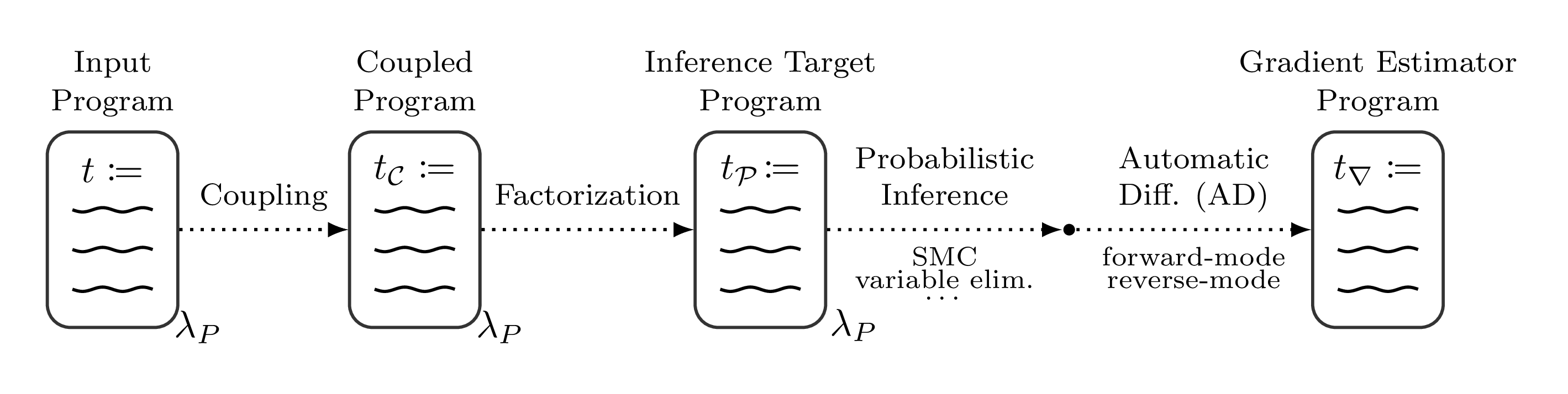
GradInf automatically synthesizes gradient estimators
(i.e., estimators of gradients of expected values [1]) for
probabilistic programs. Users define a probabilistic
program using a mix of ordinary Haskell and library-provided
primitives. They then call gradInfAD, specifying their desired
probabilistic inference strategy. The result is an unbiased estimate of
the gradient of the expectation
of the original program with respect to its parameter.
Starter Example
We can write a simple queuing model:
{-# LANGUAGE ScopedTypeVariables #-}
{-# LANGUAGE RebindableSyntax #-}

import Prelude hiding (flip)
import Numeric.GradInf.Primitives.DeterministicPrimitives
import Numeric.GradInf.Primitives.FlipCRN
import Numeric.GradInf.Primitives.IterateP

queueKernel :: forall m d i b mat.
    (DeterministicPrimitives d i b mat, FlipCRN m d b)
    => d -> i -> m i
queueKernel theta x = do
    let p = theta / (theta + if (isGreater x 25) :: b then 25 else toDouble x)
    b :: b <- flipCRN p
    let x' = if b then x + 1 else x - 1
    return x'

queueModel :: forall m d i b mat.
    (DeterministicPrimitives d i b mat, FlipCRN m d b, IterateP m i)
    => Int -> d -> m d
queueModel n theta = do
    x <- iterateP (queueKernel theta) 0 !! n
    return (toDouble x)
flipCRN) specify
factorized coupling strategies, which GradInf uses to form
lower variance gradient estimators.
We can now differentiate the program using the GradInf high-level API:
import Data.Functor.Identity
import Numeric.GradInf

let thetaToDifferentiateAt = Identity 15.0
let n = 50
gradientEstimate <- sampler $ gradInfAD (queueModel n . runIdentity) (stratifiedImportanceResamplingInferenceAlg 1) thetaToDifferentiateAt
print gradientEstimate
Here, stratifiedImportanceResamplingInferenceAlg 1 is an inference strategy
which enables sound and efficient gradient estimation.
See the tutorials in this documentation site for more details on the API.
[1] Monte Carlo Gradient Estimation in Machine Learning, Shakir Mohamed, Mihaela Rosca, Michael Figurnov, and Andriy Mnih. Journal of Machine Learning Research 21, 132 (2020),
Index
For more usage examples, check out the tutorial pages on applying GradInf to queuing models, financial models, and biochemical models. API documentation and additional tutorials will be added soon!
Citation
@article{arya2026gradinf,
title     = {GradInf: Gradient Estimation as Probabilistic Inference},
author    = {Arya, Gaurav and Huot, Mathieu and Schauer, Moritz and Lew, Alexander K. and Saad, Feras A.},
journal   = {Proceedings of the ACM on Programming Languages},
volume    = {10},
number    = {PLDI},
articleno = {243},
month     = jun,
pages     = {1864--1890},
year      = {2026},
publisher = {Association for Computing Machinery},
address   = {New York, NY, USA},
doi       = {10.1145/3808321},
}